


 Medicover
Table of contents:
What is magnetic resonance imaging? | Why choose the MRI lab at Medicover Hospital? | What does an MRI scan look like? | Is MRI safe? | How to prepare for an MRI scan and contraindications | Magnetic resonance imaging Warsaw price | Where to have an MRI scan in Warsaw?
What is magnetic resonance imaging?
Magnetic Resonance Imaging (MRI) is a non-invasive imaging diagnostic method. It uses strong, constant magnetic field and radio waves that interact with the hydrogen protons present in the tissues of the human body. This interaction gives rise to signals that are then recorded and computerised into high-resolution cross-sectional images.
MRI allows for a detailed evaluation of anatomical structures, especially soft tissues, without using ionising radiation. In some cases, the scan may be performed with a contrast agent to increase diagnostic sensitivity and achieve better definition of pathological changes.
Medicover Hospital offers MRIs of the following body areas (without limitation):
sacroiliac joints | head | elbow joints |
hip joints | thoracic spine | knee joints |
ankles | shoulder joints | cervical spine |
A whole body MRI, as a screening procedure, cannot be used as a substitute for more detailed local scans or other magnetic diagnostic procedures.
Why choose the MRI lab at Medicover Hospital?
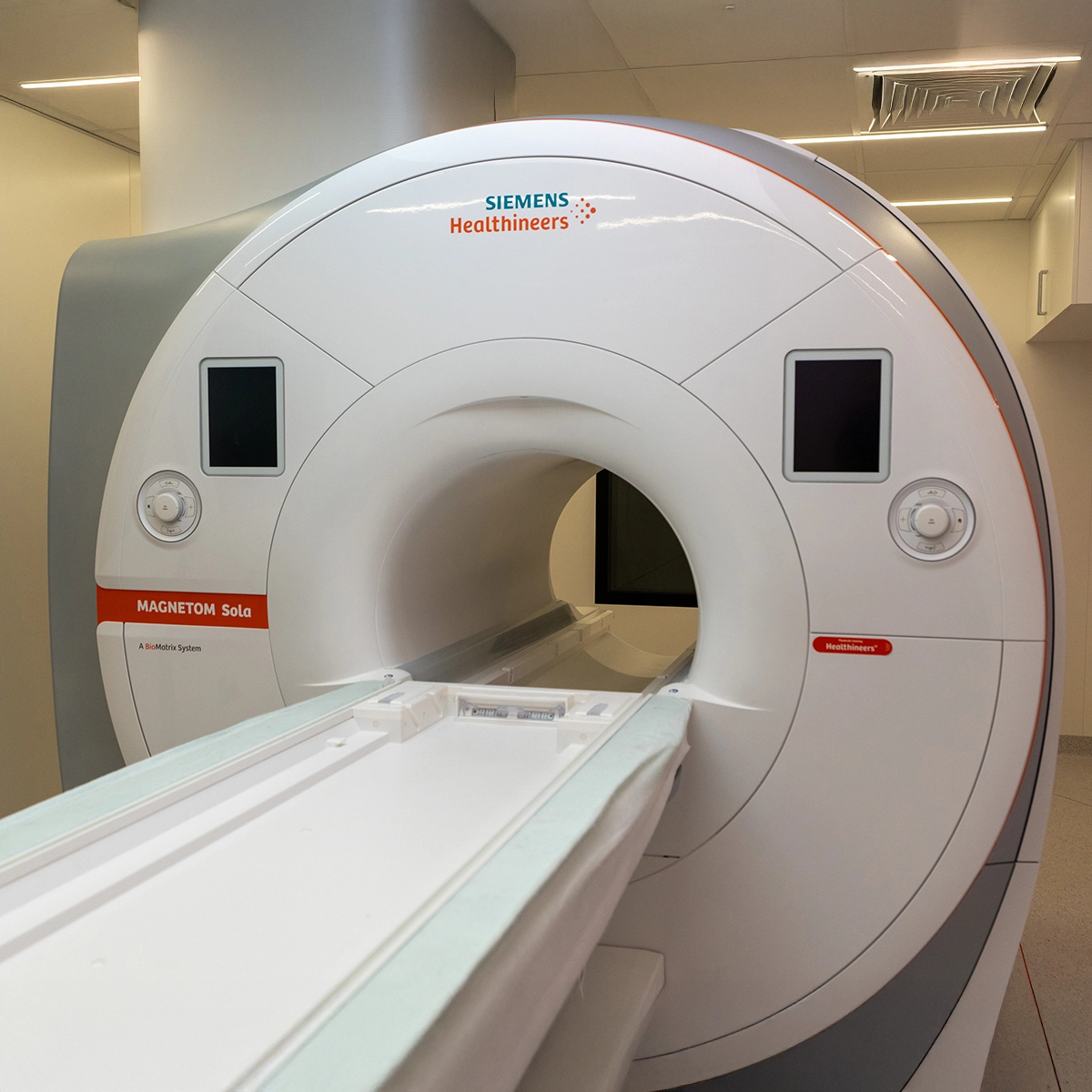
Our MRI lab combines clinical expertise, advanced technology and a high standard of patient comfort.
Why is it worth it?
Experience that matters ✔ more than 170,000 MRIs performed since 2009 ✔ efficient workflows and safety confirmed in practice | Premium technology ✔ state-of-the-art Siemens Magnetom 3 Neo scanner with AI support ✔ shorter scanning time and higher image quality | Accurate diagnostics ✔ AI support in obtaining legible images ✔ higher accuracy of reports and faster diagnostics |
Patient comfort ✔ friendly test environment ✔ solutions for people with claustrophobia | Quiet, modern facilities ✔ sleek stress-reducing interiors ✔ feeling safe from the moment you step into the room | Experienced team ✔ 20 electroradiology technicians ✔ care and support at every stage of the procedure |
All these translate into accurate diagnostics in a safe and comfortable environment.
What does an MRI scan look like?
|
|
Learn more:
Is MRI safe?
During the scan, you will stay under the care and constant supervision of the technician. You will be able to talk to them through the intercom at any time – just squeeze with your hand the rubber bulb which contains the microphone and speaker switch. In order to reduce the noise produced by the electromagnet working inside the MRI machine, you will be offered earplugs before the scan.
How to prepare for an MRI scan and contraindications
The scanner uses a strong magnetic field, so it cannot be used on patients who have implants or other objects in their bodies made of metals affected by magnetic fields (also known as ferromagnetic or paramagnetic materials).

✔ If you have any types of implants, you should inform the MRI team and provide information from the referring doctor or the doctor who implanted the device about how MRI-safe the implant is. Orthodontic braces are not a contraindication. When having an MRI of the head, it is best to take off any removable elements; retainers may stay in place. The procedure will show if there are no artefacts and if the scan will be of diagnostic value. ✔ Before having an MRI (with or without contrast) of the abdomen, pelvis, bile ducts, liver, pancreas, kidneys, or lesser pelvis, or before a venography, you should fast (eat no solid foods and drink nothing except still water) for at least 6 hours before the scan. | ✔ Before having an MR urography, you should fast for 6–8 hours before the scan; to ensure an accurate assessment of the urinary tract you should drink 0.5L of fluid up to 1 hour before the scan and not use the toilet until the procedure is completed. ✔ You should wear loose clothing, without metal elements. You must also remove and leave out any metal objects such as belts, watches, keys, jewellery (chains, earrings), lighters, hearing aids, coins, glasses and mobile phones, as well as payment cards. ✔ In order to keep your body well hydrated, it is recommended to drink about 1 litre of liquids (water, weak tea) in case a contrast agent needs to be administered. ✔ For the MRI of the head, orbits and other adjacent areas, you are advised not to use hairspray and not to apply or to remove any makeup. |
ITEMS TO BRING FOR YOUR TEST: ✔ The original referral issued and signed by the referring doctor (if issued by a medical facility other than Medicover). For formal reasons, patients without referrals who pay for the test may only undergo MRI scans that do not require an intravenous administration of a contrast agent. ✔ Previous imaging results (report + CDs), hospital discharge letters concerning the area to be scanned. ✔ If you have any implants – relevant safety information and MRI compatibility parameters. ✔ If undergoing contrast-enhanced MRI – a recent result of blood creatinine and GFR (the result must be no more than 7 days old in people with suspected renal failure or risk factors such as heart disease, hospitalisation within the last 30 days, or chronic diseases. Healthy people may present a result from the last 30 days). |
Additional recommendations before magnetic resonance imaging
✔ Jewellery (including piercings), any metal objects, mobile phones and payment cards must be left in the changing room.
✔ The presence of the following is an absolute contraindication to performing the scan: pacemakers and cardioverter-defibrillators, vascular clips (e.g. following aneurysm surgery), metallic bodies in the eye, implanted auditory prostheses.
✔ If you have any implants such as: metal elements (i.e. plates, wires, screws), metal joint prostheses, stents, artificial heart valves, ventriculo-peritoneal shunts, metal dental bridges, orthodontic appliances, retainers, or metal intrauterine devices – you are required to provide information about the material they are made of (e.g. a technical passport or certificate).
✔ If you have an orthodontic appliance (made of MRI-safe materials), it is recommended to remove as many metal parts as possible before the procedure.
✔ If you have claustrophobia, your attending doctor may recommend that you should be given a sedative. Tell the doctor about this at your first consultation.
Immediately after the scan you are allowed to drive, and you can take medications before the scan, because it does not affect how they work. The scan may be performed at any point in the menstrual cycle, including during menstruation.

Magnetic resonance imaging Warsaw price
Magnetic resonance imaging is performed with a special device that generates images which allow doctors to pinpoint the causes of pain or detect unusual changes within bones or muscles. The price of magnetic resonance imaging in Warsaw depends on the body part to be scanned. The price list is available from our consultants and on our website.
We also offer MRIs covered by the National Health Fund – a valid medical referral is required.
To learn more about the available tests, go to the hospital’s website under “diagnostics”.
